
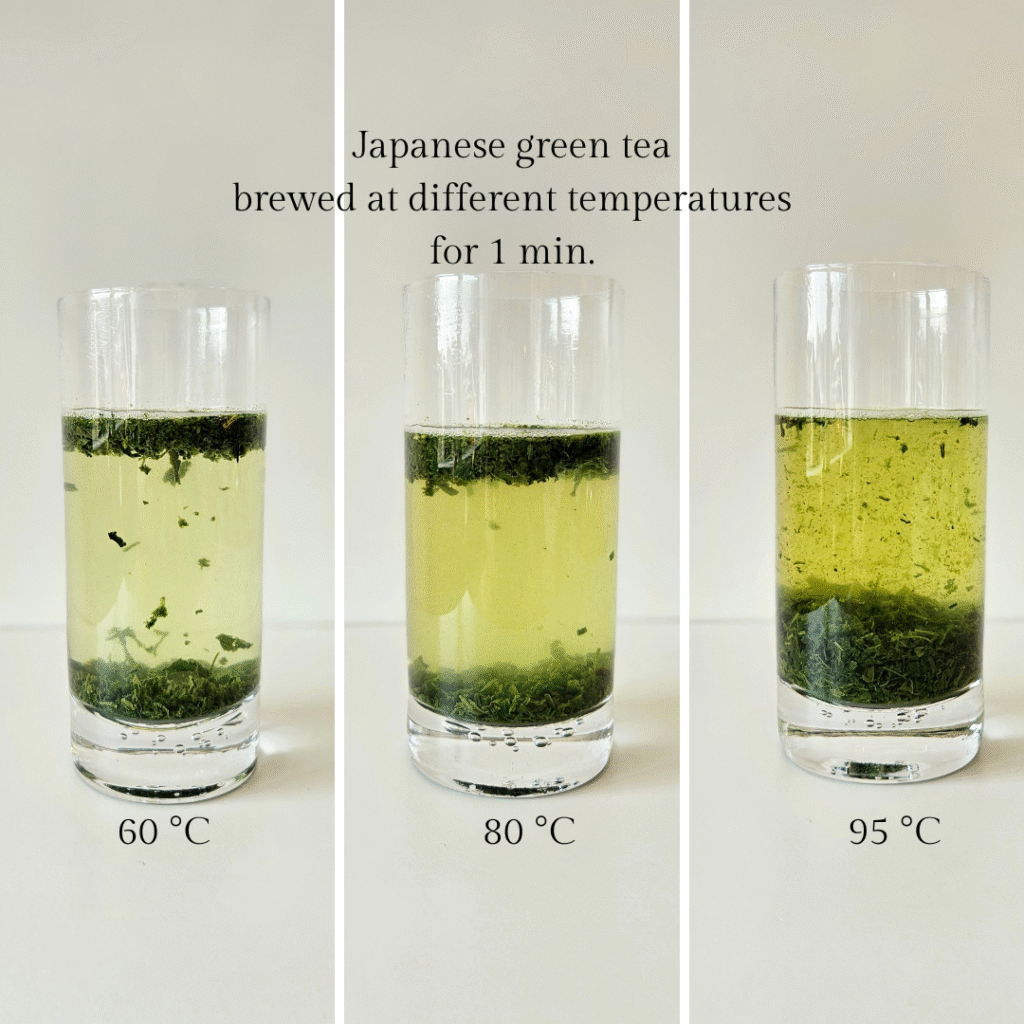
— A science-based look at taste and chemistry
Green tea is prized for its delicate umami, floral and nutty aromas, and gentle sweetness.
But if you brew it with water that’s too hot, those elegant notes can be destroyed—replaced by bitterness and harsh astringency.
Science explains why.
In fact, Ikeda et al. published research as far back as 1972 in their paper Relation Between Infusing Condition of Green Tea and Soluble Component, analyzing how the extraction of caffeine, catechins, and amino acids in green tea changes at different water temperatures over time.
Caffeine is making us awake and alert, but it is also just bitter.
Catechins add bitterness and astringency to a brewed tea.
Amino acids, mainly L-Theanine, are what we love in tea. That is the thing that makes a tea umami and sweet.
It’s the interplay of these three compounds that largely determines the taste and mouthfeel of brewed tea.
This is what Ikeda’s data tells us:
- Low Temperature Brewing (~60 °C): Good for a smooth, sweet, and umami-rich taste and mouthfeel
At approximately 60 °C, the extraction of L-Theanine, an amino acid responsible for the characteristic umami and mild sweetness of green tea, is relatively high compared to caffeine and catechins. Amino acids dissolve more readily at these gentler temperatures, preserving the delicate, umami, and sweet notes in the infusion. In contrast, the extraction of caffeine and catechins is limited, resulting in minimal bitterness and astringency. This brewing condition favors a smooth, sweet, and umami-rich cup. - Moderate Temperature Brewing (~80 °C): Good for a well-rounded taste and mouthfeel
Around 80 °C, the extraction of caffeine approaches near-peak levels, contributing a noticeable but not overpowering bitterness to the tea. Simultaneously, catechins—polyphenolic compounds associated with astringency and bitterness—are extracted at roughly half of their maximum potential, lending body and astringent mouthfeel without excessive harshness. Importantly, L-Theanine remains sufficiently extracted at this temperature to counterbalance the bitter and astringent components, resulting in a harmonious flavor profile that balances sweetness, umami, and slight bitterness. This temperature range is often recommended for green tea to achieve a well-rounded taste. - High Temperature Brewing (95 °C and above): No-go. Bitter, harsh taste and mouthfeel.
When brewed near boiling temperatures, the extraction rates of catechins and caffeine sharply increase, dominating the infusion with intense bitterness and pronounced astringency. Although L-Theanine extraction also rises, it can no longer balance the taste. Consequently, the tea brewed at these high temperatures often exhibits a harsh, less balanced flavor that may be unpleasant to many palates.
Apart from Ikeda’s research findings, it is worth noting that aromatic compounds in tea — such as those responsible for seaweed or floral notes — extract at different rates and respond differently to temperature. Brewing green tea at too high a temperature can disrupt the balance of these compounds, causing certain aromas to become overly strong or clash with others, which may lead to an unpleasant tasting experience. You can also observe that the tea liquor becomes darker as brewing temperature increases. This color change indicates that more compounds — including pigments, polyphenols, and flavor molecules — are being extracted, affecting the taste/flavor and appearance of the tea.
Conclusion:
If you aim for a balanced cup of green tea in terms of taste and mouthfeel, most green teas brew well at around 80 °C with a steeping time of 1–2 minutes.
Good to know! Thanks for sharing!